Top Black-Owned Beauty Brand CurlyCoilyTresses Creator & CEO: Angela Fields
Featured on CSC’s List of Top Non-Toxic Black Beauty Brands and Non-Toxic Black Beauty Database, we spoke to CurlyCoilyTresses® Creator and CEO Angela Fields about
Home > You searched for fragrance > Page 3
Featured on CSC’s List of Top Non-Toxic Black Beauty Brands and Non-Toxic Black Beauty Database, we spoke to CurlyCoilyTresses® Creator and CEO Angela Fields about
Director of Environmental Health and Education, We Act for Environmental Justice
Director of Environmental Health and Education, We Act for Environmental Justice
Non-Toxic Black Beauty Project BCPP’s Campaign for Safe Cosmetics is tackling the environmental injustice of Black beauty with our database of non-toxic Black-owned beauty products and list
Conscious consumers look out for toxic ingredients on product labels. However, some of the chemicals found in body washes may not be listed on the
Mixtures People aren’t exposed to just one chemical at a time. Because many ingredients are used in many products, exposures for some chemicals are nearly
Measuring Chemicals In People Biomonitoring is a technique that measures the levels of chemicals in our bodies to scientifically study their effects on our health.
Menstrual Care Products and Toxic Chemicals Many of the products we use the most intimately: menstrual care products like tampons and pads have been shown
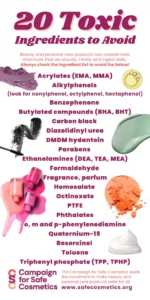
Top Toxic Ingredients in Cosmetics Use our lists below to see how your products stack up. These are the most common toxic chemical ingredients in cosmetics. For
Ethanolamines are present in many consumer products ranging from cosmetics, personal care products and household cleaning products. Both have been linked to liver tumors. The European Commission prohibits diethanolamine (DEA) in cosmetics, to reduce contamination from carcinogenic nitrosamines. [1]
Benzophenone is used in personal care products such as lip balm and nail polish to protect the products from UV light. Derivatives of benzophenone, such as benzophenone-2 (BP2) and oxybenzone (benzophenone-3 or BP3) are common ingredients in sunscreen. Benzophenone is persistent, bioaccumulative and toxic (PBT).[1][2] These chemicals are linked to cancer, endocrine disruption, and organ system toxicity.
Synthetic musks are chemicals used in personal care product fragrances. They are rarely listed on the label, since fragrance ingredients are often not disclosed.
Pronounced THAL-ates, these chemicals, which are linked to endocrine disruption, developmental and reproductive toxicity, and cancer, have been banned from cosmetics in the European Union, but still remain prevalent in U.S. products.
While the FDA requires cosmetics to list other kinds of ingredients, many fragrance chemicals are protected as trade secrets and may appear as simply “perfume” or “aroma” on product labels.
Businesses Thousands of clean cosmetic companies are joining with the Campaign for Safe Cosmetics to make safer, non-toxic beauty products the new normal. Will you
Take Action Our Campaign for Safe Cosmetics is on a mission to make beauty safer for all. Will you join us? Campaigns FDA Ban on
How to Find Safer Cosmetic Products Ready to clean up your beauty routine? We’re here to help you find safer cosmetics and personal care products, free of
Top 5 Safe Cosmetics Tips No one wants to learn that their trusted personal care products are made with hazardous chemicals. Thankfully, safer alternatives are
Health & Science All of us are exposed to toxic chemicals through our everyday use of cosmetics and personal care products as well as through
Laws and Regulations State, federal, and international laws governing cosmetics State Laws In the absence of meaningful federal oversight of the cosmetics industry, states have
Reports Scientific reports and publications September 26, 2018 Right to Know: Exposing Toxic Fragrance Chemicals in Beauty, Personal Care and Cleaning Products Fragrance chemicals made
Chemicals of Concern in Cosmetics Our Red List is a resource for businesses to assess the safety of the ingredients in the personal care products
About Us The Campaign for Safe Cosmetics (CSC) leads the movement to make beauty and personal care products safer for all. CSC is a
This suite of federal safer beauty bills addresses gaping holes in cosmetic safety by banning the worst chemicals; requiring fragrance disclosure; protecting women of color
Take Action Safer Beauty for All! Take action. BCPP’s Campaign for Safe Cosmetics (CSC) leads the movement to make beauty and personal care products safer
Governor Newsom made history today, by signing the Cosmetic Fragrance and Flavor Ingredient Right to Know Act of 2020 (SB312-Leyva) into law, making California the
SB 312 exposes chemicals of concerns hiding in the fragrance and flavors used in personal care, beauty and professional salon products — and empowers people
This legislation will also be the first to focus on the environmental injustice of beauty and require disclosure of fragrances in cosmetic products.





*You’re subscribing to BCPP’s Campaign for Safe Cosmetics email list. We won’t share your information and you may opt out at any time.